Serving Mission Viejo, CA and surrounding areas.(657) 390-1824
Saddleback Mission Viejo Concrete

Stamped Concrete in Mission Viejo, CA, Colored Through and Approved Before It Is Poured

Saddleback Mission Viejo Concrete stamps patios, pool decks and entry courts with the pigment through all 4 inches, in a color your committee has signed. Every estimate is measured and written on site.

Google reviewsFacebook reviewsBetter Business Bureau reviews5.0 Stars Rated by our customers · Google, Facebook and the BBB
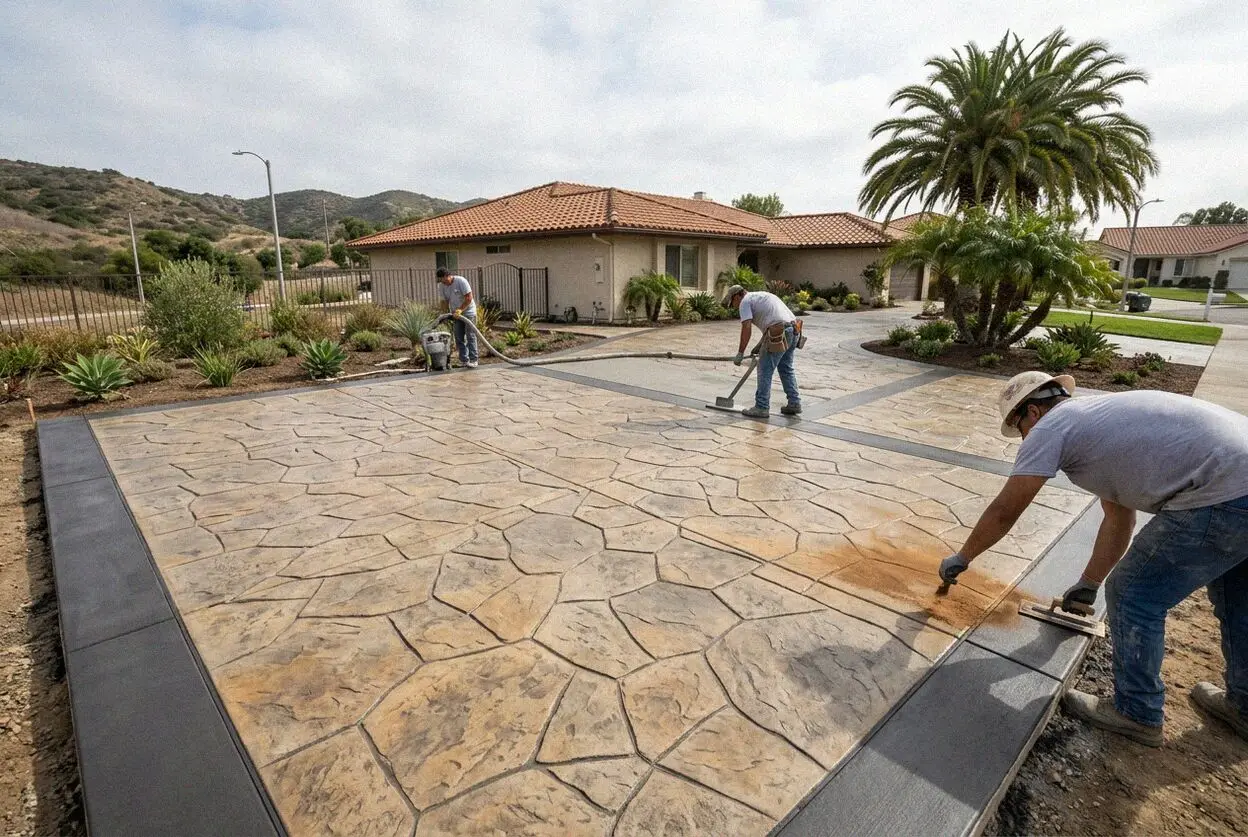
Crew pressing a slate pattern into a fresh stamped patio in Mission Viejo
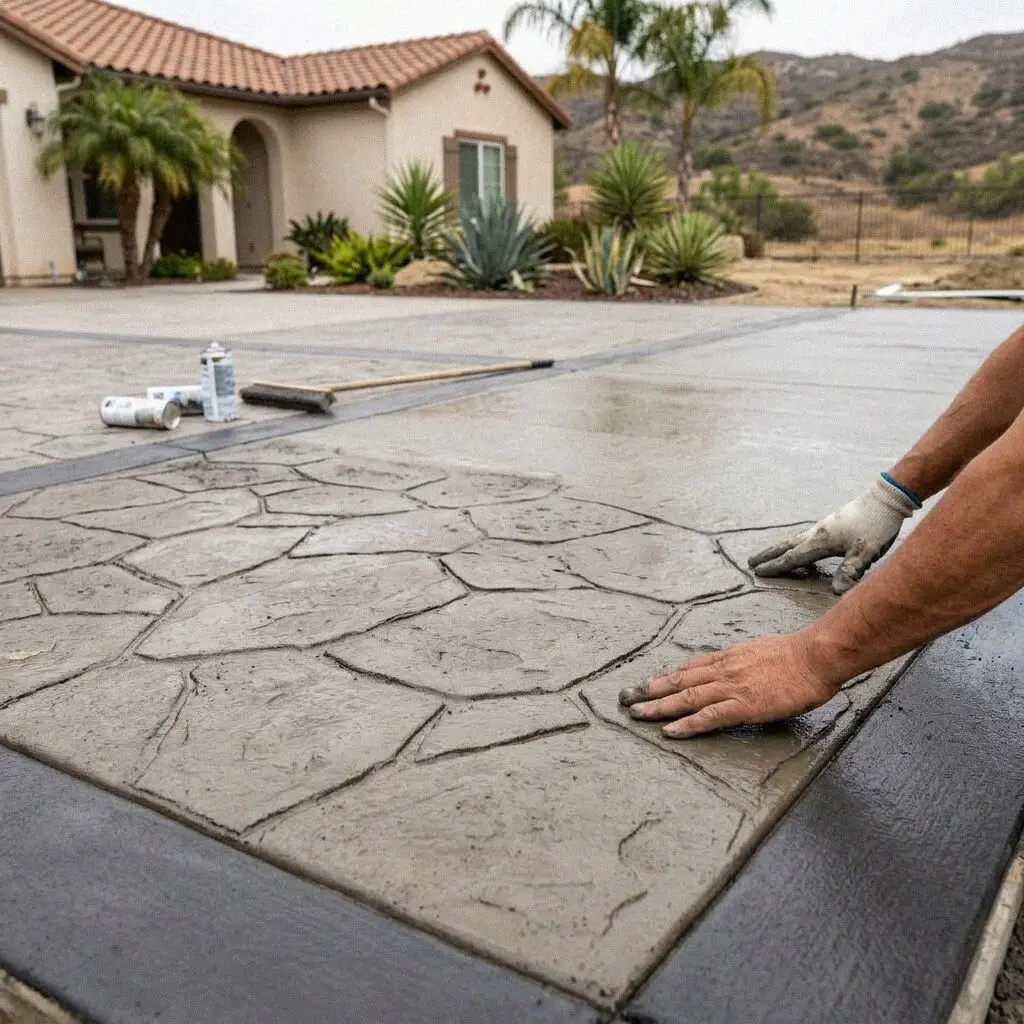
Hands lifting a texture mat off a colored stamped slab in Mission Viejo

How a stamped slab is built here

Stamping a Patio on a Mission Viejo Yard

A stamped slab is a plain slab with two things added while it is soft, a color and a texture, and both are there for good once it hardens. That is what sets it apart from a broomed patio. A plain slab that fades is only a slab, while a stamped one that fades is the wrong color in plain view of the street and the yard, with no way to press it again. So the color goes through the whole mix rather than onto the top, and the pattern is chosen for where you will actually see it from.

Saddleback Mission Viejo Concrete has stamped concrete in Mission Viejo since 2018, and Trevor Lindqvist chooses the mat and the release with you at the visit and works the stamping line himself at every pour. He spent 17 years on flatwork crews across south Orange County before the business, most of it on graded pads like these, where a texture that reads as stone from the sliding door can read as a mistake from the top of a slope. The mat is picked for the sightline.

Every stamped slab is 4 inches of 3,500 psi concrete over compacted base, colored through, jointed on the pattern's lines and sealed once dry, built under a CSLB C-8 concrete license with liability insurance on every job. Where an association has an architectural committee, the chip and the pattern go in a submittal written with the estimate, so the review is done before a form is set. It carries a written workmanship guarantee against defects in how it was built.


Redo or repour

When is a Mission Viejo stamped patio past saving?

Color gone pale in the sun

A slab colored only on the surface, with a dry shake or a stain, wears through where chair legs land and bleaches where the afternoon sun hits, so a west facing patio is two colors inside a decade. A tint gone gray in patches is a surface color, and new stain is a patch on a patch.

Sealer turned white or peeling

A milky haze across the stones, or clear flakes lifting at the edges, is sealer that went on before the slab had dried or went on too thick. It traps moisture under itself and clouds. It can be stripped from a sound slab, but where the color has gone, stripping shows what was lost.

Chips along the pattern ridges

The raised grout lines of a stamp are the thinnest concrete on the slab, and on a step nosing or an edge they chip first. A few chips are wear. Chips along the length of an edge mean the slab was stamped too late, after the surface began to set, and the texture is loose.

A crack cutting across the stones

A crack through the middle of a stone rather than along a grout line was not planned for. It means the joints were cut off the pattern, or not cut, and on a Mission Viejo pad it is often the seam between cut and fill showing through. It will keep opening, and no color hides it.

In every stamped slab

What Goes Into a Stamped Slab in Mission Viejo

Eight things are in every stamped job and none is a line you can strike out, because each one answers a way a stamped slab fails on a yard like this one, in full sun, on a graded pad, and in plain view of the street and the association's committee.

The old slab broken out

The existing patio, pad or walk is broken out and hauled to the crusher the same day, and the ground under it is opened to see what it sat on.

The pad probed for fill

Test holes at both ends of the area find the fill side of the pad, and the base goes deeper there, so the seam under the slab stays under it.

Base compacted in lifts

4 inches of crushed base, placed in layers and plate compacted, gives the stamp a bed that does not move, since a stamped slab cannot be patched.

Color through the mix

Pigment goes into the truck at the plant, so the color runs the full 4 inches and a chip or a worn patch shows the same color underneath.

Joints on the grout lines

The control joints are drawn onto the pattern before the pour and sawn along grout lines, so a shrinkage crack lands where a stone edge already is.

The mats laid in one line

The stamp is pressed in order across the slab while the surface is at one stiffness, so the texture depth at the far edge matches the first mat.

The submittal written

The color chip, the pattern and a plan drawing go to your architectural committee with the estimate, so the review runs while the schedule is set.

Sealed, walked, guaranteed

The release is washed off, the slab dries out, sealer goes on at 28 days, and the written guarantee is handed over on the walk-through.

Pattern and color

Stamped Finishes for a Mission Viejo Yard, Compared

Four patterns most of the stucco and tile houses here take well, set against how each reads from the street, how the color goes in, and what it asks of a yard on a slope. The base, the depth and the joint rule under all four are the same.

OptionReads asColor inOn a slopeReseal
Ashlar slateCut stone, from the street or the yardIntegral base with a darker releaseTerraces well, the courses set the step linesEvery 2 to 3 years
Random flagstoneFieldstone, read close upIntegral base, one or two release tonesRuns with any fall, no lines to keep trueEvery 2 to 3 years
Running bond brickA brick court, matches a tile roofIntegral terracotta with a sand releaseWants a level pad, courses show any driftEvery 2 to 3 years
Seamless slate textureOne stone surface with no grout linesIntegral color, sawn grid the only linesAny fall, the joints alone set the panelsEvery 2 to 3 years

Seamless texture asks least of the crew and most of the eye, since it hides nothing; the two stone patterns cost most to press and pass a committee fastest.

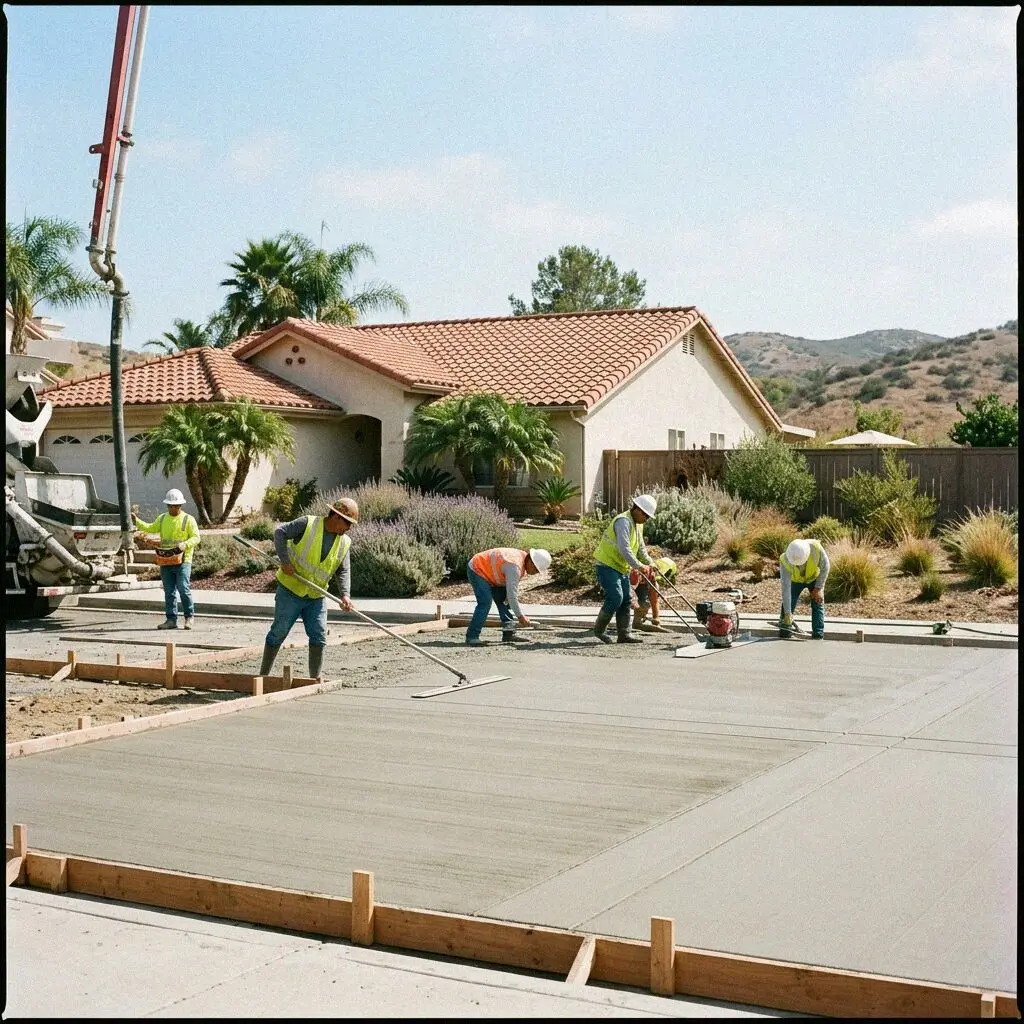
Concrete crew at work on a colored stamped patio behind a Mission Viejo home

Sun, slope and the committee

Why a Stamped Slab Is Chosen Differently Here

A stamped slab here is seen from three places at once, the street, the house and the slope above or below it, and it is judged by a committee before it is judged by you.

Almost every tract in the city, from the 1960s Deane Homes to Painted Trails in the 1990s, sits under an association whose architectural committee reviews anything visible from the street, and a stamped entry court or a corner lot side yard is visible. The committees tend to hold the houses to the earth tones the Mission Viejo Company set out with, cream and tan stucco under red tile, so a slate gray that passes inland is questioned on a Casta del Sol cul-de-sac.

The slope and the sun are the second thing. Most rear yards here drop or climb from the door, so a patio is poured as terraces with a step between and the pattern's own courses set the step lines, and the sealer is what stands between the color and an afternoon sun that sits on a west facing pad from May to October. The Santa Ana weeks in the fall cut the stamping window to under an hour, so those pours start at first light. Where a terrace needs holding, the retaining wall goes first.

From chip to sealer

How We Stamp a Slab in Mission Viejo

Five stages, and the person who holds the color chips against your stucco at the first one is on the stamping line at the fourth. The association's review sits between the second and the third, and the pour is dated once it is back.

1

Measure, probe, hold up the chips

Trevor Lindqvist measures the area, probes the pad for fill, shoots the fall and holds the chips to the house. The figure is written on the spot.

2

Pick the mat, file the submittal

You pick the mat, the base color and the release from samples. The plan and the chip go to your committee the same week, with the estimate.

3

Break out and build the base

The old slab goes to the crusher, the fill side is dug deeper, and 4 inches of base is compacted in lifts and checked under a plate.

4

Pour, color, release and stamp

The colored mix is placed and floated, the release cast, and the mats go down in one line before the surface stiffens. Joints are sawn by evening.

5

Wash, dry, seal and walk through

The release is washed off at 2 days, the slab dries for 28, and the sealer goes on. We walk it against the estimate and hand over the guarantee.

Behind the number

What Sets the Estimate on a Mission Viejo Stamped Slab

The area starts the figure and the pattern finishes it. Two patios of one size can be a day apart in stamping once a border, a second color and a terrace are drawn, so nothing is quoted from a photo. Every estimate is measured and written on site.

The single-family rear patio

One color, one pattern, one level, reached through a side gate. The line pump from the curb and the width of the gate set most of what moves here.

The condo or lakeside townhome

A shared wall and an association that owns the ground outside your door mean a longer review and a narrower way in, so the crew works in halves.

The terraced yard or pool deck

A patio stepping down a slope or wrapping a pool is built as separate pours with a joint at every level, each level priced as its own area.

Borders, two colors and antiquing

A contrasting border, a second release color or a hand antiqued finish is each one more pass across the soft slab, and the passes are the labor.

The visit and the written figure cost nothing, and the call that books it comes within 1 business day. The submittal to your committee is part of the estimate. (657) 390-1824 or send us a message.

Ready to see the color chips against your house?

Send the form or call, and someone rings back within 1 business day to fix a time. Trevor Lindqvist measures the yard, probes the pad, holds the chips to your stucco and writes the figure at your home, and it is yours to keep.

Request a Free Estimate

Written on site · No obligation

By submitting, you agree to our disclosure and consent terms, including being contacted by Saddleback Mission Viejo Concrete.

Slabs we stamped

Three Mission Viejo Stamped Slabs, in Their Owners' Words

Three reviews from Google, Facebook and the BBB, each about a stamped slab rather than a plain one, and each naming the pattern or the color that was chosen and how it has held.

Google review

“Our back patio faces west and the old stamped one had gone from tan to almost white in the sun. Trevor put the color through the mix this time and matched it to the stucco off a chip, and after two summers you cannot see a difference between the shaded half and the sunny half.”

Marta R. of Casta del SolStamped patio replacement · Google · 2024
Facebook review

“We wanted a stamped entry court on a corner lot and the committee had turned down our neighbor's. Trevor wrote the submittal with the ashlar sample and the chip and it was approved in three weeks. The pour was 380 square feet and the joints run along the stone lines, so nothing shows.”

Glen T. of CordovaStamped entry court · Facebook · 2025
BBB review

“Our yard drops about 3 feet from the door, and they poured the patio as two terraces with a step between, flagstone on both, in a sand color. It has had one wet winter and one hot October on it and neither level has moved or cracked, and the sealer went on a month later like they said.”

Priya S. of Painted TrailsTerraced stamped patio · BBB · 2026

Before you book

Stamped Concrete Questions Asked in Mission Viejo

What moves the figure on a stamped slab, how long the pattern takes, who has to approve the color, what sealer goes on and when, and what is guaranteed once it has dried, answered for a yard here.

(657) 390-1824
  • What moves the estimate on a stamped concrete patio?

    The pattern and the passes, more than the area. A single color under one mat is one pass across the slab; a border band, a second release color or an antiqued finish is each another pass while the surface is soft, and each is labor on the day. After that it is the ground, since a soft fill side adds a day of digging, and the access, since a slab pumped over a fence costs the pump. All of it is measured on site.

  • How long does a stamped patio take from pour to use?

    About a month before it is sealed and finished, though you walk on it much sooner. The crew is on site 3 to 4 days, a day to break out, a day for base and forms, a morning to pour and stamp, and a return at 2 days to wash off the release. Feet can go on it at 48 hours and furniture at 7 days. The sealer waits until the slab has dried, at 28 days, and the sealed surface is walkable the next morning.

  • Does the estimate include the sealing and the color?

    Yes, both, and the submittal to your association as well. The pigment, the release, the stamping, the sawn joints, the wash and the first coat of sealer at 28 days are on the one figure, as is breaking out the old slab and hauling it. What sits outside it is named at the visit, a step or a wall found when the old slab is out, or a second color added after the chip is chosen. The number you sign is the bill.

  • Does a stamped patio need approval in Mission Viejo?

    From your association, usually yes, and from the City only if it is more than a slab. Most Mission Viejo tracts sit under an architectural committee that reviews a change visible from the street, and a stamped finish is a color choice, so an entry court or a corner side yard nearly always goes through it. We write the submittal with a chip, a photo and a plan. A flat patio inside your lot line needs no permit.

  • Will insurance pay for a stamped slab that faded or cracked?

    Not for fading, and not for a crack that came from the ground. Sun on the color and shrinkage in the slab are wear in a homeowner policy, and settlement of the pad is excluded from most of them outright. A slab broken by something sudden, a vehicle, a tree down in a Santa Ana wind or a burst pool line washing the base out, can be a claim. Photograph it before anything is broken out and ask your carrier first.

  • What does the guarantee cover on stamped concrete?

    The build, meaning the base compacted, the 4 inches poured, the color through the mix, the joints sawn on the pattern and the sealer applied once the slab had dried. It is a written workmanship guarantee against defects in how it was built, its terms on the estimate you sign. Sealer wearing in the sun, chair scuffs and fill settling under the pad are not defects. A fault in the build, we come back and fix it.

  • What color and sealer go into a stamped slab?

    An iron oxide pigment batched into a 3,500 psi mix at the plant, a powdered release in a darker tone cast over the surface before the mats go down, and a solvent based acrylic sealer once the slab has dried at 28 days. The mats are polyurethane, in the pattern you chose from the sample, and the pigment and release names go on the estimate so the color can be matched if the slab is ever extended.

  • Do I need to be there while the patio is stamped?

    For the chip and pattern choice at the start, the walk-through at the end, and one morning between them, the pour, for the first mat. The first mat sets the pattern's orientation to the house and the depth of the texture, and it is the last point at which either can change. After that the crew needs water, an unlocked gate and the yard clear. On sealing day nobody needs to be home, but pets do.

Towns we stamp in

Stamped Concrete Around Mission Viejo

The eight nearest towns on the list, with the straight-line distance from the office on La Paz Road beside each. Every stamped slab is measured and the chips held against the house before a figure is written.

Show All Areas We Serve

Book a free measure of your Mission Viejo stamped slab

Call or send the form and you hear back within 1 business day. Say which yard the slab is for and whether your association reviews it, and the visit can be booked for a day inside the same week, chips included.