Serving Mission Viejo, CA and surrounding areas.(657) 390-1824
Saddleback Mission Viejo Concrete

Concrete Sidewalk Building in Mission Viejo, CA, for Walks That Climb From the Curb

Saddleback Mission Viejo Concrete builds the walk from the curb to your door on the grade the pad sets, as a walk, a ramp or steps, 4 inches over base. Every estimate is measured and written on site.

Google reviewsFacebook reviewsBetter Business Bureau reviews5.0 Stars Rated by our customers · Google, Facebook and the BBB
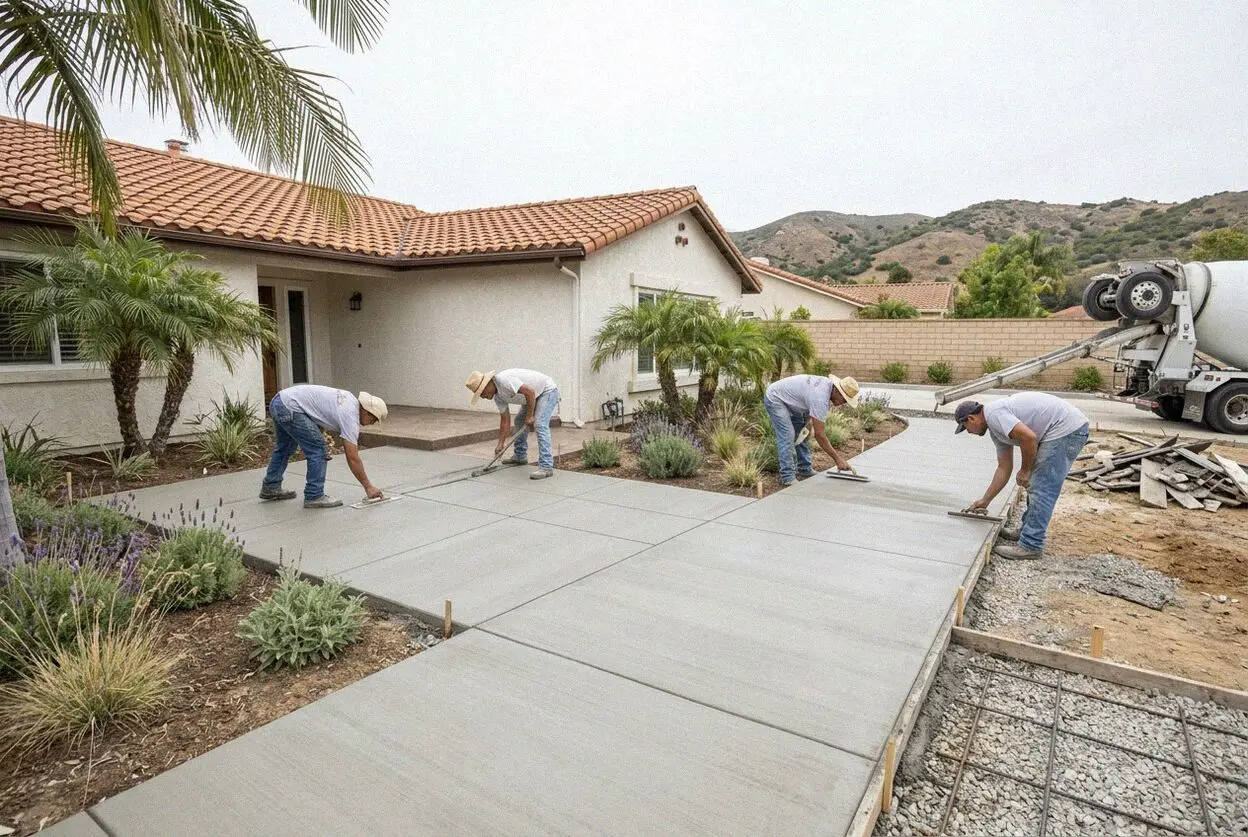
Crew forming a new concrete entry walk up a sloped front yard in Mission Viejo
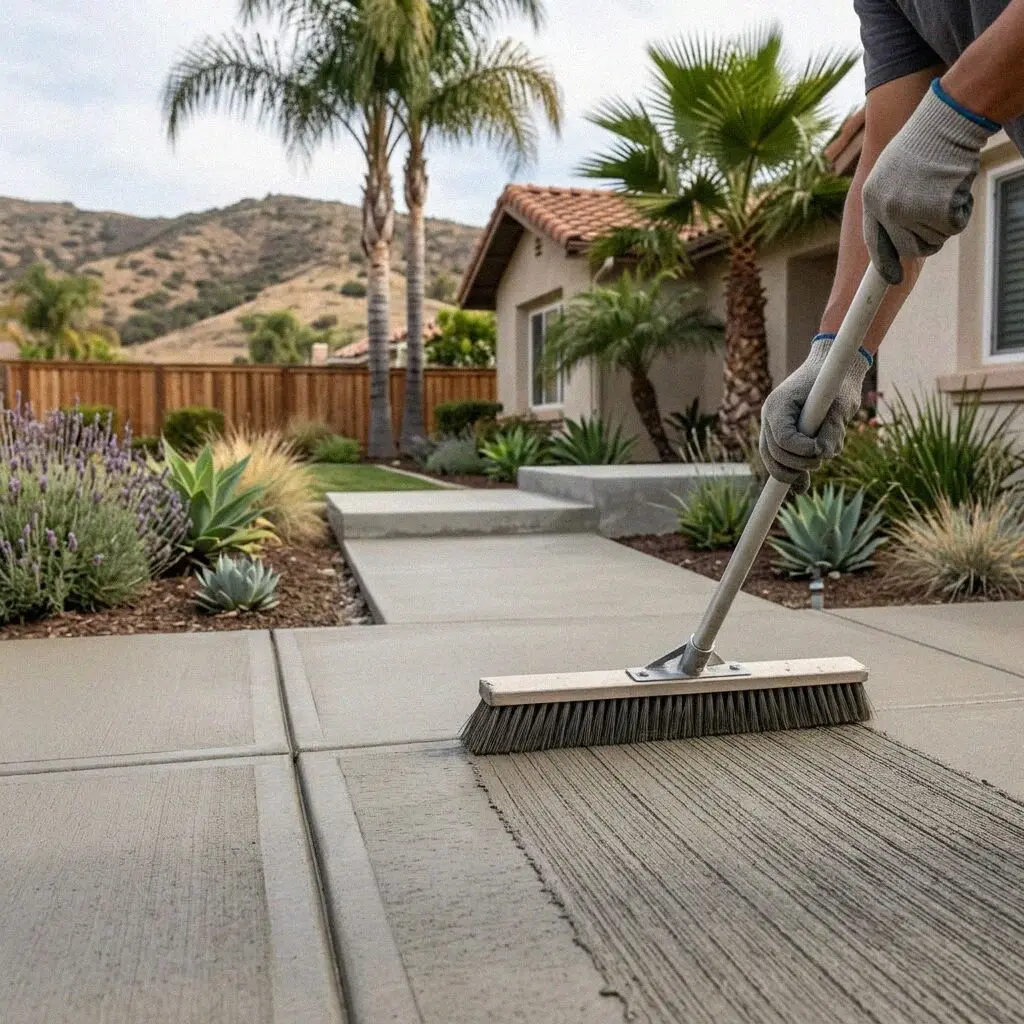
Hands brooming a fresh concrete walk beside a Mission Viejo front step

How a walk is built here

Building a Walk on a Mission Viejo Front Yard

A walk is the one slab a person uses on foot every day, so its fault is not a crack but a lip, a pitch or a step in the wrong place. On a flat lot a walk is a strip of concrete. On a Mission Viejo pad the house sits above or below the street, so the walk has to climb, and a slab tilted up a slope is a slide in the first rain. It is built instead as a walk to a fall of 1 in 20, a ramp with landings up to 1 in 12, or steps beyond that, and the grade shot at the visit decides which.

Saddleback Mission Viejo Concrete has built walks in Mission Viejo since 2018, and Trevor Lindqvist shoots the grade on every estimate himself. Of his 17 years on flatwork crews across south Orange County, most were spent on tract pads like these, where the front walk was poured with the house in one season and has been lifting at the cut and fill seam ever since. He is on the forms at every pour, so the fall you agreed to at the visit is the fall the walk is finished at.

Every walk is 4 inches of 3,500 psi concrete over compacted base at 36 inches or wider, with a cross fall to shed water and joints at the width, built to the California Residential Code under a CSLB C-8 concrete license with liability insurance on every job. A panel behind the curb is in the City's right-of-way, and it is done on an encroachment permit from the City of Mission Viejo. It carries a written workmanship guarantee against defects in how it was built.


Repair or replace

When is a Mission Viejo front walk past repairing?

A lip you catch a toe on

One panel standing higher than the next, by a quarter inch or more, is the first thing a walk does wrong and the one that trips people. Grinding the lip flat buys a year or two. If the panel is still rising, from a root or the fill settling, the lip comes back on a thinner panel.

Water sitting on the walk

A puddle on a walk after the sprinklers run means the cross fall is gone, because the panel has tipped toward the house or was poured flat. Standing water on a hillside walk finds the next joint and runs under the slab, and the base it takes with it is what held the panel level.

A pitch too steep to walk down

A walk that has you leaning back on the way to the mailbox was poured as one tilted slab to save the forming of steps. Wet, it is a slide. The fix is not a rougher broom on the same pitch but a run rebuilt as a ramp with landings or as steps, the forming that was skipped.

A crack across the width

A crack straight across a walk midway between two joints, with one side a little lower, is the line where the pad turns from cut to fill. The fill side is still settling and the walk was poured over the seam with no joint. It keeps dropping until the panel is rebuilt with one there.

In every walk

What Goes Into a Mission Viejo Sidewalk

Eight things are in every walk at no separate line, and each answers what a front yard here does to one, a grade between the curb and the door, a seam under the pad, sprinklers running most nights and a parkway tree older than the concrete.

The old walk out

Every panel is broken out and hauled the same day, down to soil, and a root that lifted one is cut back where an arborist would cut it.

The grade shot

The fall from the curb to the door is measured with a level, and that figure decides whether the run is a walk, a ramp or steps.

Base proved under a plate

4 inches of crushed base, plate compacted, and deeper on the fill side of the pad so both halves of the walk sit on the same bed.

Width to the Code

36 inches at the least, the width the California Residential Code asks of a path to the front door, and wider where the step meets it.

Cross fall to the lawn

A quarter inch of fall per foot across the walk, toward the lawn, so sprinkler water leaves the slab instead of finding the joint.

Joints at the width

Control joints every 4 to 5 feet on a 4-foot walk, and one placed on the cut and fill seam, so the two halves of the pad can move apart.

Steps where the grade asks

Any run steeper than 1 in 12 takes risers, poured solid on a footing and never stacked, so a step is a step and not a tilted panel.

Walk-through and guarantee

We walk the run with you against the estimate, fall, width, joints and finish, and hand over the written guarantee before we leave.

How it can be built

Mission Viejo Sidewalk Builds, Compared

Four ways to build a walk on a pad here, set against the grade between the curb and the door, since that is what decides it. The base, the concrete and the joint rule under all four are the same, so the table is about the run itself.

OptionGrade it takesWidth of itThicknessBack in use
Broomed walk on a fallUp to 1 in 20 from curb to door36 inches, wider at the door4 inches over 4 of baseFeet at 24 to 48 hours
Ramped walk with landings1 in 20 to 1 in 12, a landing every 30 feet36 inches with a raised edge on the fall4 inches, fiber in the mixFeet at 24 to 48 hours
Stepped walkSteeper than 1 in 12, risers under 7 3/4 inches36 inches between the cheeksPoured solid on a footingFeet at 48 hours
Public panel at the curbFlat, with the City's cross fall4 to 5 feet, to the City's standard drawing4 inches, 6 across a drivewayFeet at 24 hours, cars at 7 days

The stepped walk takes the most forming and the curb panel the least; the ramp is the one an older resident thanks you for, and what most walks here should have been.

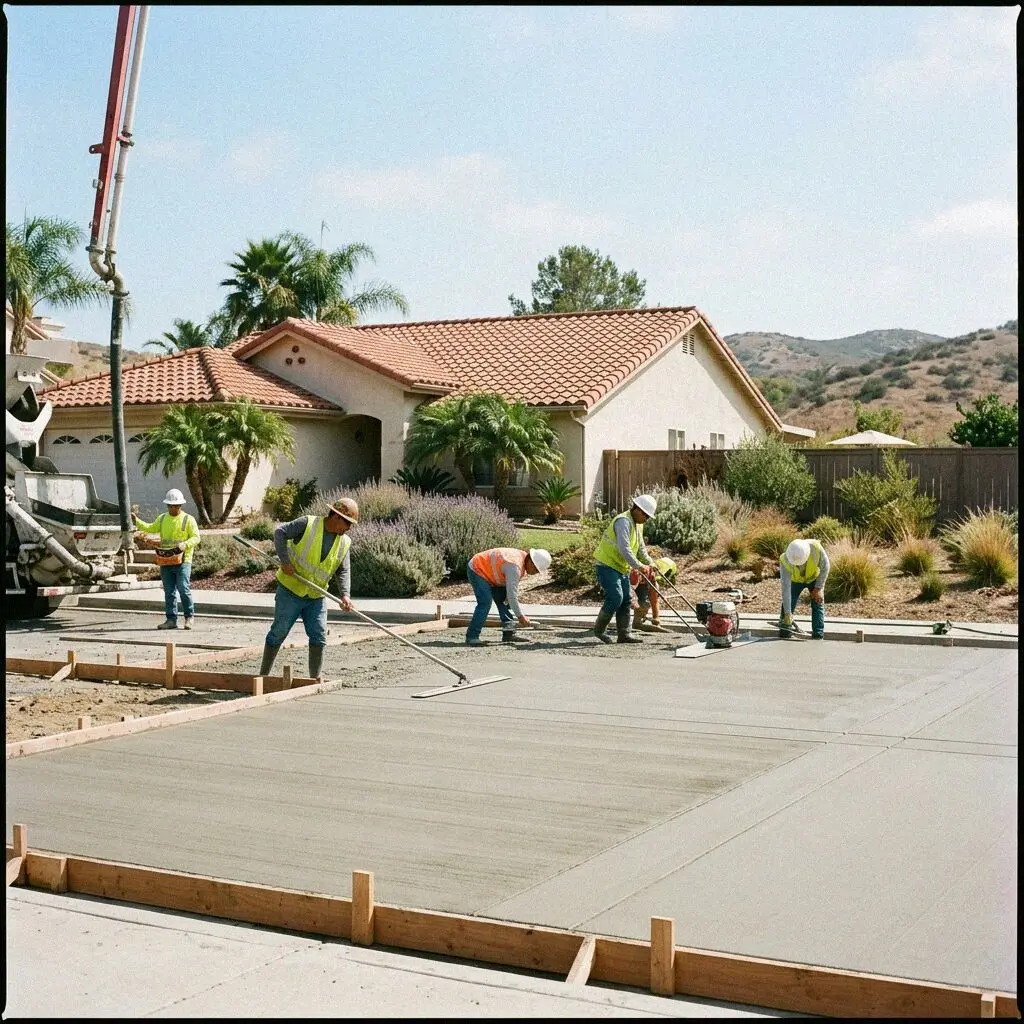
Concrete crew forming a stepped entry walk on a Mission Viejo front slope

Grade and seam

Why a Walk Is Built to a Grade in Mission Viejo

A walk here has a climb in it and a seam under it, and the two decide more about how it is built than its length does.

The city was graded out of the foothills in terraces, and on most streets the pads sit a few feet above the curb on one side and below it on the other, so a front walk from the Deane Homes tracts of the 1960s to Pacific Hills in the 1990s has a fall in it, often 3 to 5 feet between the sidewalk and the door. Poured as one tilted slab, that run is a slide in rain and a hazard to anyone with a cane, which matters on the Casta del Sol streets where most residents are past 55.

The seam is the second thing. Every pad was made by cutting the hill on one side and filling the other, and the front walk is the slab most likely to cross that line, since it runs from the street edge of the pad to the house. The fill settles for decades, so a walk poured over the seam with no joint cracks there and drops on one side, the lip that trips people. So the seam is found at the visit and a joint goes on it. Where a run is too steep for a ramp, the steps go first.

From call to cure

How We Build a Mission Viejo Sidewalk

Five stages, the same crew at each, and the person who shoots the grade at the first is setting forms at the fourth. A curb panel is permitted before the breaker starts, and a walk seen from the street goes to the association first.

1

Shoot the grade, probe the pad

Trevor Lindqvist measures the run, shoots the fall from the curb to the door and probes the pad for its fill side. The figure is written there.

2

Choose walk, ramp or steps

The grade sets the choice, you pick the finish and take a date. An encroachment permit or an association submittal is filed the same week.

3

Break out and dig

The old panels go to the crusher, a lifting root is cut back, and the fill side is dug until the base bed proves under a plate rather than by eye.

4

Base, forms, pour and broom

Base compacted, forms set to the fall and the cross fall, steps formed on their footing, then a morning pour broomed across the line of travel.

5

Cut, cured and handed over

Joints sawn the same day, one on the seam, the walk kept damp for 7 days, the beds raked back and the paperwork handed over on the walk-through.

Behind the number

What Sets the Estimate on a Mission Viejo Walk

The grade starts the figure and the ground finishes it. Two walks of one length can be a day apart in forming once one of them needs steps, which is why nothing is quoted from a photo or the street. Every estimate is measured and written on site.

The single-family entry walk

Curb to door on one lot, 3 to 4 feet wide. The fall between the two ends sets whether it is a walk or steps, and that sets most of the forming.

The condo or townhome common walk

A walk the association owns and several doors share is a submittal to its board, worked in halves so no door is cut off, and dated to the review.

The walk down a side slope

A run from the front yard to the rear on a hillside lot is a walk, a ramp and steps in turn, each priced as its own length on its own footing.

Exposed aggregate and color

A salt finish, an exposed aggregate wash or an integral color is one more pass, and a colored walk is a submittal where a gray one is not.

The visit and the written figure cost nothing, and the call that books it comes within 1 business day. A curb panel is checked with the City first. (657) 390-1824 or send us a message.

Ready to have your Mission Viejo walk measured?

Send the form or call, and someone rings back within 1 business day to fix a time. Trevor Lindqvist shoots the grade from the curb to your door, probes the pad and writes the figure at your home, and you are free to sit on it.

Request a Free Estimate

Written on site · No obligation

By submitting, you agree to our disclosure and consent terms, including being contacted by Saddleback Mission Viejo Concrete.

Walks we rebuilt

Three Mission Viejo Walks, in Their Owners' Words

Three reviews from Google, Facebook and the BBB, each about a walk rather than a patio or a drive, and each naming the grade that was dealt with and how the run is used now.

Google review

“Our front walk in Deane Homes was the original 1960s one, tilted straight up the yard, and my mother would not use it. Trevor rebuilt it as a ramp with a landing halfway and a raised edge on the low side. She walks it with her frame now, and the rain runs off the side instead of down it.”

Ron F. of Deane HomesEntry walk rebuilt as a ramp · Google · 2023
Facebook review

“The walk had cracked across the middle and one half had dropped an inch. He showed me the seam where the pad changed from cut to fill and put a joint right on it in the new walk. That was two winters ago and both halves are still flush, which the old one never managed.”

Ana M. of Pacific HillsFront walk replacement · Facebook · 2024
BBB review

“Our yard drops 4 feet from the door to the street and the old walk was too steep for anyone in Casta del Sol to use. They poured five steps on a footing at the top and a walk below them, 4 feet wide with a broom finish, and it was ready to use two days after the pour.”

Lise K. of Casta del SolStepped front walk · BBB · 2026

Before you book

Sidewalk Questions Asked in Mission Viejo

Whose walk it is, what the grade does to the figure, how long the front door is cut off, which panel the City permits, and what is guaranteed once the forms are off, answered for a pad here.

(657) 390-1824
  • What moves the estimate on a concrete walk?

    The fall between its two ends, before its length. A run the grade allows as a plain walk is forms, base and a morning's pour; the same run needing a ramp with landings or a flight of steps is a footing, risers and cheeks, and the forming is most of the labor. After that it is what comes out, a root or a soft fill side, and the finish. All of it is measured at your home and written down before we leave.

  • How long is my front door cut off while the walk is rebuilt?

    Two to three days, and never entirely. The crew is on site a day to break out and dig, a day for base and forms, and a morning to pour and broom, and the walk takes feet again 24 to 48 hours after that. Through the pour and the first day you reach the door across the lawn or through the garage, and on a run with steps the flight is poured first so the top is usable while the lower walk cures.

  • Does the estimate include breaking out the old walk?

    Yes. Breaking out the old panels, hauling them, cutting back a root that lifted one and digging out a soft fill side are all in the figure, as are the joints, the broom finish and the clean-up. What sits outside it is named at the visit rather than added after, a step found under the old walk, a sprinkler line through the base, or an encroachment permit fee for a panel at the curb. The number you sign is the bill.

  • Do I need a permit for a sidewalk in Mission Viejo?

    Not for the walk inside your lot line; the California Residential Code exempts it. The panel behind the curb is in the City's right-of-way and needs an encroachment permit from the City of Mission Viejo, which we file and meet the inspector for. A walk seen from the street also goes to your association's architectural committee where you have one, and we write that submittal with the estimate.

  • Will insurance cover a lifted or cracked front walk?

    Rarely, and the walk matters to your policy for the opposite reason. Settlement, root lift and shrinkage cracks are wear in a homeowner policy, so a walk that has lifted over 30 years is yours to rebuild. Where a policy is engaged is liability, since a lip on your walk that trips a visitor is a claim against you, which is why a raised panel is worth fixing before the fall and not after. Ask your carrier.

  • What is guaranteed on a newly built sidewalk?

    The build, meaning the base compacted, the 4 inches poured, the width, the fall and the cross fall set, the joints cut at the width and on the seam, and the finish. It is a written workmanship guarantee against defects in how it was built, its terms on the estimate you sign. A root lifting a panel from a tree we left, staining and fill settling on are not defects. A fault in the build, we come back and fix.

  • What concrete goes into a walk and its steps?

    A 3,500 psi ready-mix placed the morning it is batched, Caltrans Class 2 base under it, fiber through any ramp, and number 3 rebar through steps, which are poured solid on a footing rather than built up on fill. The surface is broomed across the line of travel so it holds a shoe when wet. The mix and the steel are named on the estimate, so what arrives on the truck can be checked against what you agreed.

  • Do I have to be home while the walk is poured?

    Only for the measurement at the start and the walk-through at the end. In between the crew needs water, the sprinklers off along the run, and the front door reached another way for a day or two. If the walk is the only way in, say so at the visit and the run is poured in two halves so one is always open. On a stepped walk the flight goes in first, so the top of the yard is reached from the day after.

Towns we pour in

Concrete Sidewalks Around Mission Viejo

The eight nearest towns on the list, with the straight-line distance from the office on La Paz Road beside each. Every walk has its grade shot at the property before a figure is written.

Show All Areas We Serve

Book a free measure of your Mission Viejo walk

Call or send the form and you hear back within 1 business day. Say roughly how far the door sits above or below the street and whether the walk is yours or the City's, and the visit is booked inside the same week.