Serving Mission Viejo, CA and surrounding areas.(657) 390-1824
Saddleback Mission Viejo Concrete

Concrete Steps Construction in Mission Viejo, CA, Set Into a Hillside Lot's Grade

Saddleback Mission Viejo Concrete builds flights that take up the drop between a Mission Viejo street and its door, set out from the rise measured there. Every estimate is measured and written on site.

Google reviewsFacebook reviewsBetter Business Bureau reviews5.0 Stars Rated by our customers · Google, Facebook and the BBB
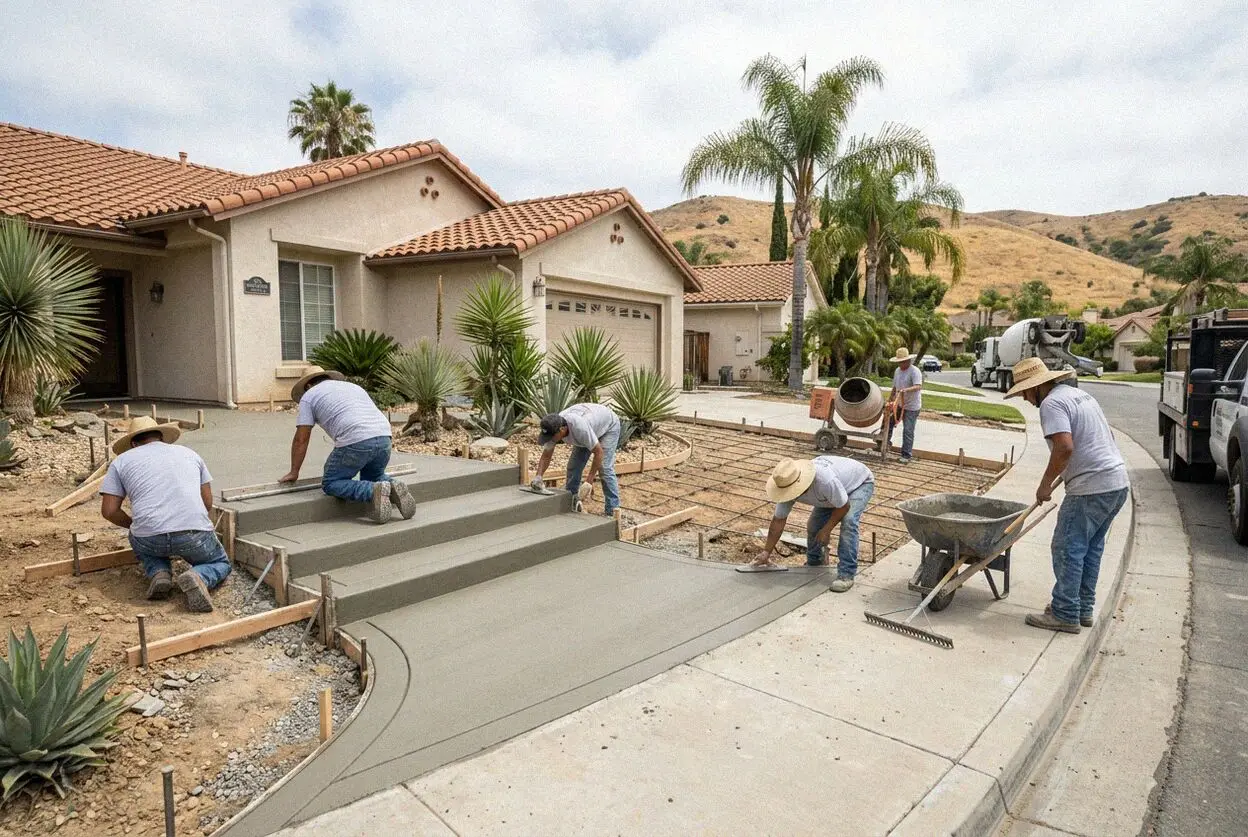
Concrete steps being formed up a sloped front yard in Mission Viejo, CA
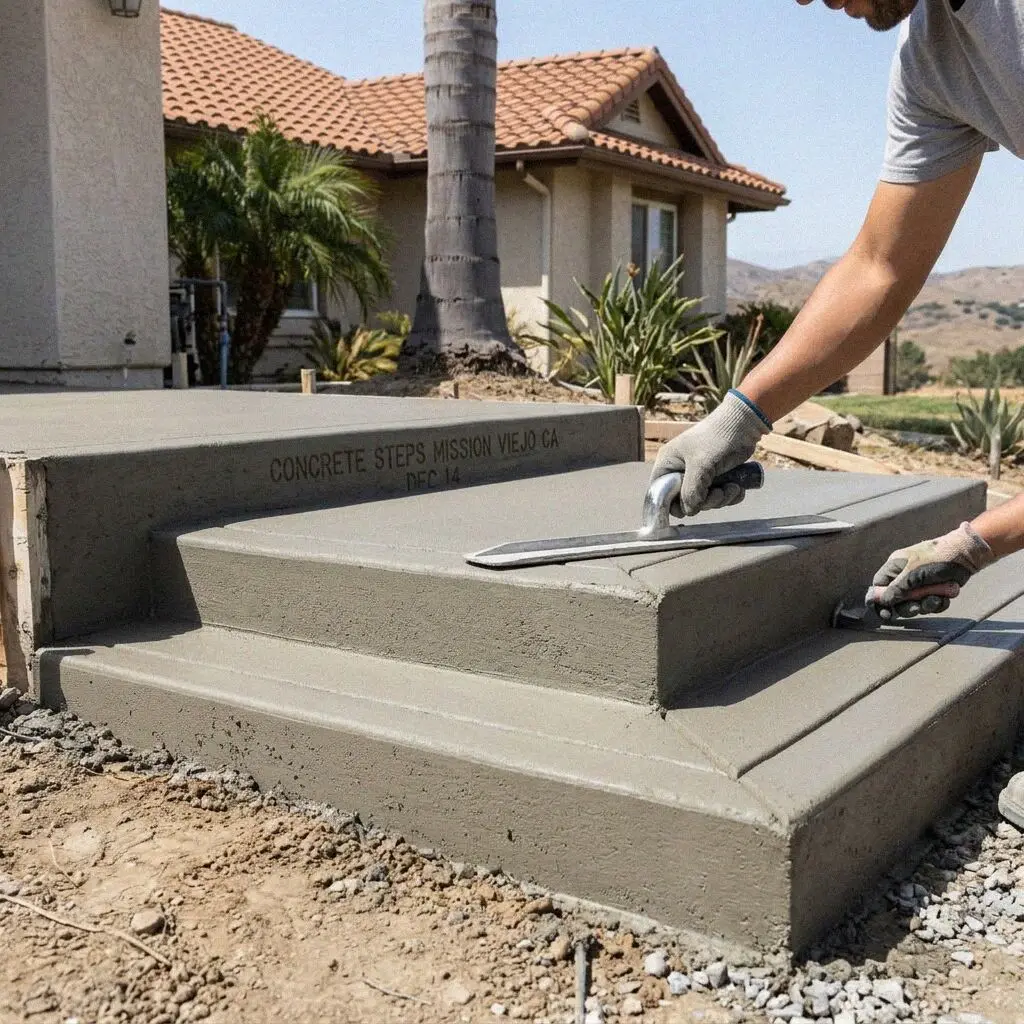
Hands setting a riser form for new concrete steps in Mission Viejo

The flight on a slope

Building Steps Into a Mission Viejo Front Yard

A flight of steps here is a piece of the lot's grading, not an ornament at the door. The Mission Viejo Company set houses above the street on one side of a road and below it on the other, so the front walk on half the streets climbs from the sidewalk to a sill well above it, and the side yard behind a pool home drops as far again to the deck. The flight is what makes that change of level walkable, and it is built from the rise, the run and the ground beside it, in that order.

Trevor Lindqvist founded Saddleback Mission Viejo Concrete in 2018 after 17 years on crews across south Orange County, and a hillside flight is the job he sets out himself, with a tape and a level, before anyone digs. The original walks here were often loose flights of precast blocks, or railroad-tie risers cut into the bank, and the bank has crept into them for forty years. He measures the total rise, divides it into equal risers, and only then decides where it turns.

Steps are built to the California Residential Code, which holds a riser to 7 and 3/4 inches at most, a tread to 10 inches at least, and every riser within 3/8 of an inch of the others, under a CSLB C-8 license with liability insurance on every job. Four risers or more take a handrail, and a front flight is what the association sees first, so its finish goes in with the estimate. The flight carries a written workmanship guarantee against defects in how it was built.


Repair or replace

When is a Mission Viejo flight of steps past repair?

One riser taller than the rest

Stand at the bottom and sight up the flight. A riser an inch taller or shorter than its neighbors is the step people trip on, and it usually means the top or bottom step has moved rather than the middle. A flight cannot be fixed one step at a time; the rise has to be divided again.

The bank spilling onto the treads

Soil, bark and gravel washing across the treads after every rain is the slope beside the flight moving into it. Steps cut into a bank with no walls at their sides lose their edges first, and sweeping does not stop the bank. The flight needs cheek walls to hold the ground off the run.

A gap between the top step and porch

A crack or gap where the flight meets the porch slab or the door landing means the flight has settled away from the house on the fill it stands on. Water runs down the gap to the footing and the flight keeps dropping. The top step ties a flight to the house, so it is rebuilt whole.

Precast blocks rocking underfoot

Steps built from stacked precast units or railroad ties rock once the ground under them has washed. A block that moves under one foot moves more under two, and a rail post set in it moves with it. That is the flight to replace with one poured piece on a footing before somebody falls.

In every flight

What Goes Into a Mission Viejo Flight of Steps

Eight things are in every flight at no separate line, and each answers what a graded lot asks of a stair: a rise fixed by the house, a bank on one side or both, and fill at the bottom that has been settling since the pad was made.

The old flight comes out

Blocks, ties or a cracked poured flight are broken out and hauled, and the bank behind them is cut back to a face that can be walled.

The rise measured twice

The total rise is shot from the sill to the walk with a level, then divided into equal risers before a form is cut, so no step is the odd one.

Footing past the fill

A footing 12 inches into undisturbed ground under the bottom step and the cheek walls, because the front of a pad is where the fill is.

Cheek walls hold the bank

Poured walls at each side of the flight, tied to the steps with rebar, so the slope beside the run stays where it is and off the treads.

Risers formed even

Every riser formed to one height within 3/8 of an inch, treads at least 10 inches deep with a nosing, pitched a little forward to shed rain.

Tied to the porch

Dowels drilled and epoxied into the porch or landing slab, so the top step and the house move as one piece rather than pulling apart.

Handrail sleeves cast in

Where the flight has four risers or more, sleeves for a rail are cast in the pour, so a rail can be set without cutting the new steps.

Walk-through and guarantee

The flight walked with you against the estimate, rise, tread, walls and finish, and the written guarantee handed over before we leave.

How it can be built

Mission Viejo Steps, Four Ways to Build Them

Four ways to take up the drop between the street and the door, judged against the one thing a hillside lot asks of a stair, which is whether it holds its levels while the bank beside it and the fill under it keep moving.

OptionSuitsHolds the bankSteel in itLasts
Straight poured flightUp to 8 risers to a porch on a mild gradeNo, needs a planted bank either sideNumber 3 rebar on the footing30 to 40 years
Flight with cheek wallsA run cut through a bank, any riseYes, the walls are the retainingRebar tied wall to step30 to 40 years
Turned flight, landingA rise too long for one run, a garage aboveYes, walls on the long legRebar through the landing30 to 40 years
Precast block stepsA garden drop of 2 or 3 risersNo, the bank runs onto themNone, the blocks sit looseShortest of the four

Precast blocks are the least to lay and the first to move; a flight with cheek walls costs the most and is the only one that also holds the slope.

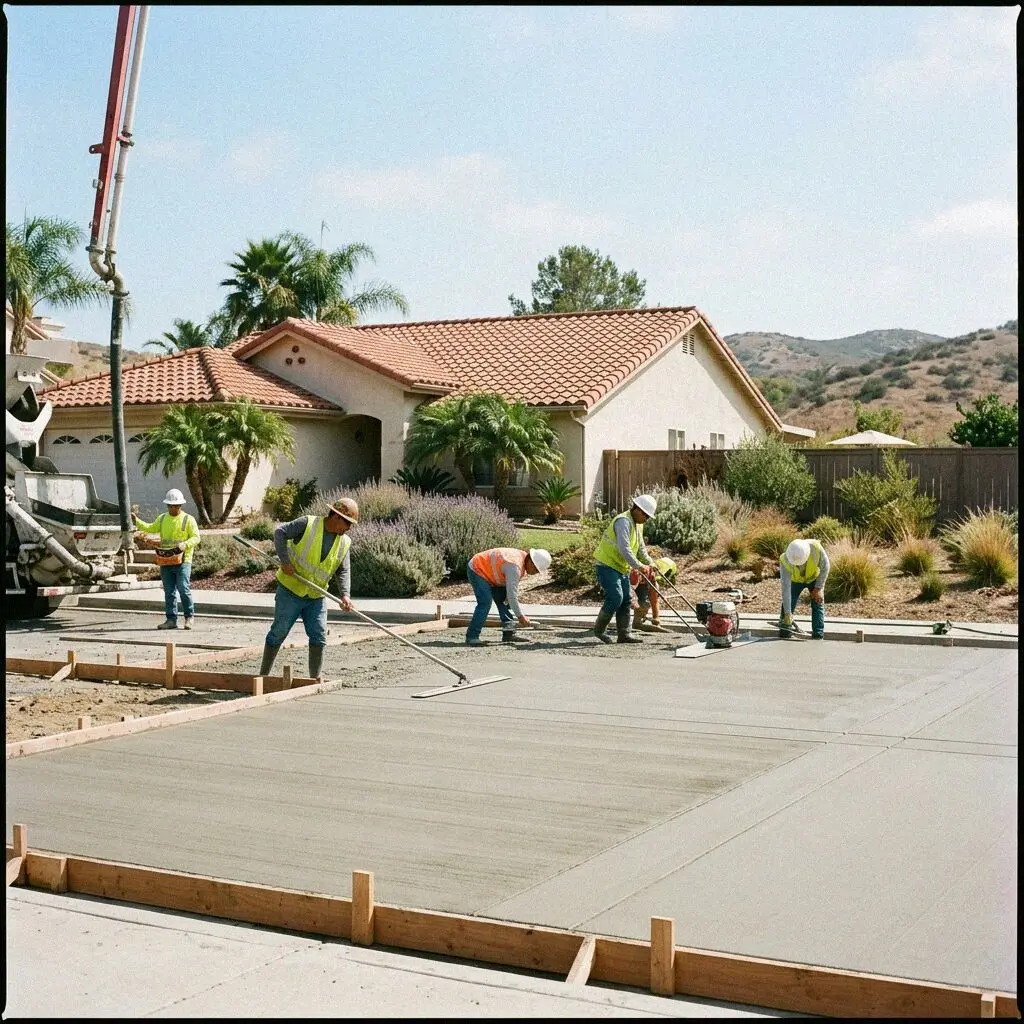
Concrete crew at work on a hillside flight of steps in Mission Viejo

Street, pad and bank

What a Flight of Steps in Mission Viejo Has to Climb

Two things fix a flight of steps here and neither is the door. The difference in level between the street and the pad, and the manufactured bank between them that the flight is cut through.

Because the city was graded into the foothills, a pad rarely sits level with its street. On the uphill side of a road the house stands above the sidewalk with a planted bank between them, and the walk climbs it, usually in two flights with a landing at the turn. On the downhill side the garage meets the street and the living floor sits a half story below, so the flight runs down a side yard to a patio, often on to a pool deck. The bank either way is fill, and it creeps.

The house end is fixed and the street end is not. A sill or a porch slab has stood at one height since the tract was built, and the sidewalk grade belongs to the City, so the total rise is what it is and the flight is designed backward from it. Equal risers first, the number of treads next, then where the landing falls so no run is longer than the code allows. Where the cheek walls would stand taller than the steps, the retaining wall comes first and the flight is built against it.

From call to cure

How We Build a Flight of Steps in Mission Viejo

Five stages, the same crew at each, and the person who measures the rise at the first visit is the one setting the riser forms at the pour. A flight seen from the street goes to the association before any digging starts.

1

Measure the rise, probe the bank

Trevor Lindqvist shoots the rise from sill to sidewalk, drives a bar into the bank and the bottom landing, and writes the figure before he leaves.

2

Set out the flight, pick the week

You choose straight or turned, the finish and the rail, and a date. The drawing goes to the architectural committee if the flight faces the street.

3

Break out and cut the bank back

Old blocks, ties or concrete are hauled out, the bank is cut back to a face for the walls, and the footing trench goes down past the fill.

4

Footing, walls, risers, pour

The footing poured, walls and riser forms set to the divided rise and checked twice, dowels epoxied into the porch, and the flight poured whole.

5

Stripped, cured and walked

Forms off the next morning, nosings eased, kept damp 7 days, rail sleeves cleared, and the flight walked with you against the estimate.

Behind the number

What Sets the Estimate on Mission Viejo Steps

The rise starts the figure and the bank finishes it. Two flights of the same height can be a day apart once the ground beside them is probed, which is why no flight is quoted from a photo of the door. Every estimate is measured and written on site.

A front walk up to a porch

A single straight flight from the sidewalk to a porch on the uphill side of the street, with a planted bank kept either side, is the base case.

A path shared by a row of doors

A flight shared by several front doors in an association is built in halves so every door stays reachable, and the rail is in the estimate.

A side yard down to a pool

A turned flight through a bank to a deck a story below, walls on both sides and a landing at the turn, is measured as walls and steps together.

Stone treads and color

A stamped or colored finish, or stone treads set on the poured flight, is measured as its own area and matched to what the committee approved.

The visit and the written figure cost nothing, and the call that books it comes within 1 business day. The rise is measured, never guessed from the step count. (657) 390-1824 or send us a message.

Have the rise at your Mission Viejo door measured

Send the form or call, and someone rings back within 1 business day to set a time. Trevor Lindqvist measures the rise, probes the bank and writes the figure at your house, and the number stays good while you think about it.

Request a Free Estimate

Written on site · No obligation

By submitting, you agree to our disclosure and consent terms, including being contacted by Saddleback Mission Viejo Concrete.

Flights we built

Three Mission Viejo Flights, in Their Owners' Words

Three reviews left on Google, Facebook and the BBB, each about steps on a graded lot rather than a slab, and each saying what the flight had to climb or drop.

Google review

“Our front walk in Aegean Hills climbed the bank in three sets of railroad ties and the middle set had rolled out. They cut the bank back, poured one flight of nine risers with walls both sides and doweled the top into the porch. The mail carrier said he no longer looks down on it.”

Diane R. of Aegean HillsFront walk rebuilt through a bank · Google · 2024
Facebook review

“The steps from our patio down to the pool in Laguna Hills had one riser 2 inches taller than the rest and my father-in-law fell on it. Trevor Lindqvist measured the whole drop, split it into twelve even risers with a landing, and set the rail sleeves in the pour. It walks right in the dark.”

Paul N. of Laguna HillsTurned flight down to the pool · Facebook · 2025
BBB review

“We are below the street in Mission Viejo and the old precast blocks down the side yard rocked. They dug a footing past the fill, poured the flight and the wall against the bank as one, and the bark that used to end up on every tread stays where it is. Two winters on, nothing has moved.”

Ana G. of Mission ViejoSide yard flight and cheek walls · BBB · 2026

Before you book

Concrete Step Questions Asked in Mission Viejo

What moves the figure on a flight, how long the door is out of use, what the City and the association each look at, what is guaranteed and what the steel is, answered for a stair on a graded lot.

(657) 390-1824
  • What makes one flight of steps cost more than another?

    The rise and the bank, before the width. A flight of four risers to a porch on level ground is forms, a footing and one pour; a flight of twelve through a front bank needs the bank cut back, cheek walls on both sides and a landing, and the walls are usually more concrete than the steps. After that it is the finish and whether a rail is part of it. All of it is measured at the house, from the sill down.

  • How long is the front door out of use for new steps?

    About a week from break-out to walking on it. Digging and the footing take a day, forms and the pour a second, and the forms come off the next morning, but the flight is kept off for 7 days while it cures. A front flight that is the only way to the door is built in two halves, or the side gate becomes the door for the week. Full strength is at 28 days, which is when a rail is set in its sleeves.

  • Does the estimate include the walls beside the steps?

    Yes, where the flight runs through a bank. The cheek walls, their footing and the drain behind them are itemized on the same estimate as the steps, because a flight cut into a slope without them fills with the slope. Removing and hauling the old blocks or ties, and doweling the top step into the porch are in the figure. What sits outside it is named at the visit: a sprinkler line to move, or a rail chosen late.

  • Do new steps need a permit in Mission Viejo?

    A flight on its own, inside your lot line, is exempt under the California Residential Code, but the cheek walls beside it are retaining walls, and one holding more than 4 feet measured from the bottom of its footing takes a permit from the City of Mission Viejo's Building Division. Anything at the sidewalk is the City's right-of-way and is permitted as such. Most associations review a front flight's finish first.

  • Will homeowners insurance pay for steps that have settled?

    Almost never. A flight that has dropped on settling fill, blocks that have rocked loose and a bank that has washed onto the treads are treated as wear rather than a sudden loss. The exception is a covered event, a burst line under the walk washing the footing out, or a slope failure in a storm where the policy covers it. Photograph the flight before anything is broken out, and ask your carrier before you book us.

  • What is guaranteed once the flight is finished?

    How it was built: the footing past the fill, the risers held within 3/8 of an inch of each other, the walls tied to the steps, the dowels into the porch and the finish, with the terms printed on the estimate before you sign. It is a written workmanship guarantee against defects in how it was built. The bank moving above the walls, staining, and wear of the nosings sit outside it. Where the fault is ours we fix it.

  • What concrete and steel go into a flight of steps?

    A 3,500 psi ready-mix poured in one piece, number 3 rebar on the footing and through the risers, number 4 bar in a cheek wall that holds more than a few feet of bank, and half-inch dowels epoxied into the porch slab. A flight is not laid on a gravel base like a slab; it stands on its footing, and the ground under the treads is put back and compacted in lifts. The bar sizes and the mix are named on the estimate.

  • Do I have to be home while the steps are built?

    Only for the measurement at the start and the walk-through at the end. Between them the crew needs a hose tap and, on the downhill side of a street, the side gate open, since the mixer stands at the curb and the concrete goes down by barrow or line pump. The front door is out of use for the week the flight cures, so a second way in is agreed at the visit. Dogs stay inside on the pour day.

Towns we pour in

Concrete Steps Around Mission Viejo

The eight nearest towns on the list, with the straight-line distance from the office on La Paz Road beside each. Every flight is measured from the sill down at the house before a figure is written.

Show All Areas We Serve

Book a free measure of your Mission Viejo steps

Call or send the form and you hear back within 1 business day. Say whether the house sits above or below the street and roughly how many steps are there now, and the visit is booked for a day inside the same week.